M.S. in Advertising Thesis
To complete my M.S. in Advertising degree at the University of Illinois, I had to research, conduct an experiment, write, and defend a master’s thesis. The topic I chose was brand anthropomorphism and what factors go into consumer processing of this phenomenon.
Key Skills:
Quantitative Research
Online Experiment (MTurk, Qualtrics)
Data Analysis (SPSS)
Hypothesis Testing
Academic Writing
Thesis Defense
Brand Anthropomorphism
Brand anthropomorphism is the process in which consumers interact with brands like humans and/or view them as human-like entities. Brand anthropomorphism is an extremely common marketing/advertising technique: some mainstream examples from brands include spokes characters such as as Martin the gecko (Geico), Tony the Tiger (Frosted Flakes), or even more subtle details, such as the “smile from a to z” hidden in the Amazon logo.




There is a lot of literature about brand anthropomorphism and its direct effects: e.g. using brand anthropomorphism results in ___). However, I found the literature seems to have a gap in exploring consumers’ internal processing when faced with brand anthropomorphism. I chose to center my research on exploring how consumers process brand anthropomorphism and what the most important internal factors in affecting their attitudes and intentions are.
Background
The internal factors that I chose to focus on are involvement, warmth, and competence.
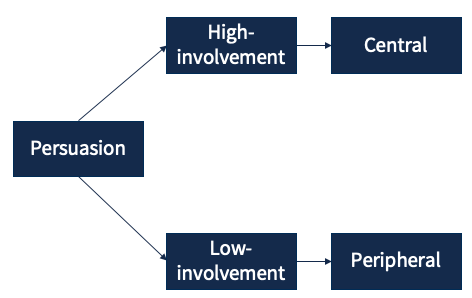
Involvement is a measure of situational importance that; i.e. when faced with a persuasive message, how important (high-inv.) or not important (low-inv.) is it to you?
When people are under high-involvement conditions, they tend to process aspects of an argument that speak to that message’s “true merit”. For example, in a car commercial this may be the price, safety ratings, fuel efficiency, etc; these are central arguments. Low-involvement conditions dictate that people will process things that aren’t as relevant to the message’s true value. For example, in that car commercial this could be the presence of a celebrity endorser, how shiny the car was, the endorser’s attractiveness: these are peripheral arguments.
Warmth and competence are the two constructs that individuals judge new people/groups on when trying to form an initial impression of the situation. Warmth is a measure of trustworthiness and friendliness, while competence is a measure of skill and intelligence. Brand anthropomorphism has been seen to have a positive relationship in warmth throughout literature, but the relationship between BA and competence has had more varied results.

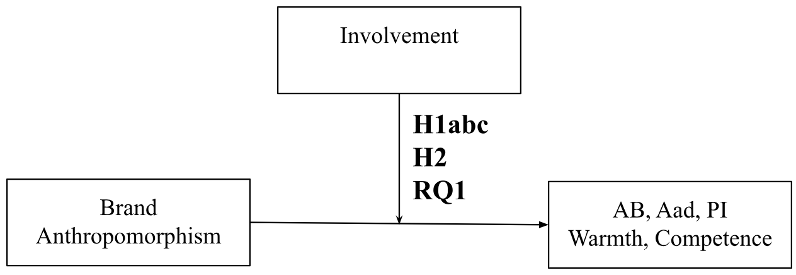
I hypothesized that brand anthropomorphism would be the most effective for consumers under low-involvement conditions, since the anthropomorphism of a brand should not be a central argument. The dependent measures I chose for this relationship were attitude toward brand, attitude toward ad, purchase intention (H1abc), warmth (H2), and competence (RQ1).
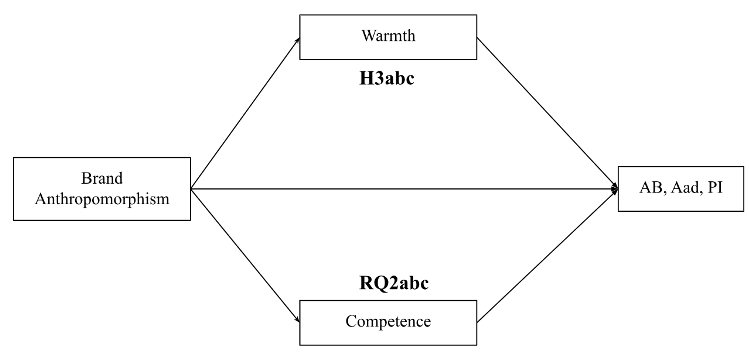
Additionally, I hypothesized that warmth would mediate the relationship between brand anthropomorphism and attitude toward brand, attitude toward ad, purchase intention (H3abc). I left the mediating effect of competence as a research question (RQ2abc).
Structural Model of Hypotheses and Research Questions
Research
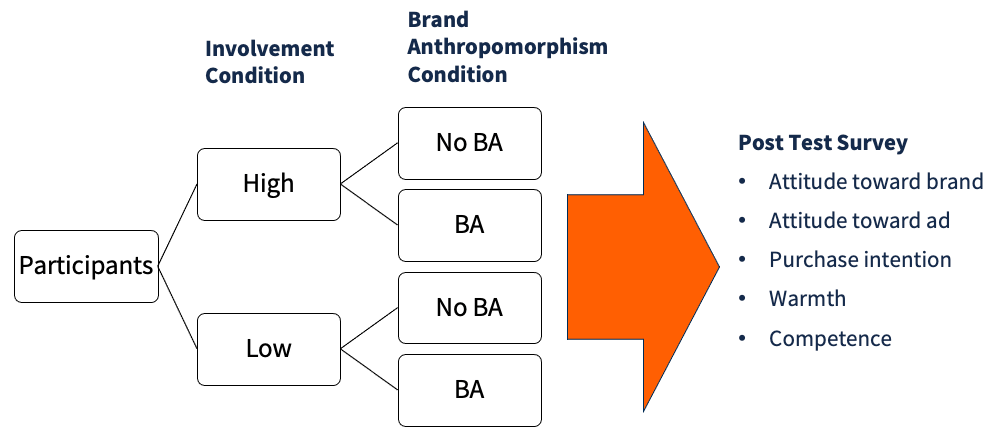
I constructed a 2 (brand anthropomorphism: yes or no) x 2 (involvement: high or low) factorial experiment to test my hypotheses and research questions. Recruitment was done through Amazon Mechanical Turk and the experiment was conducted using Qualtrics.
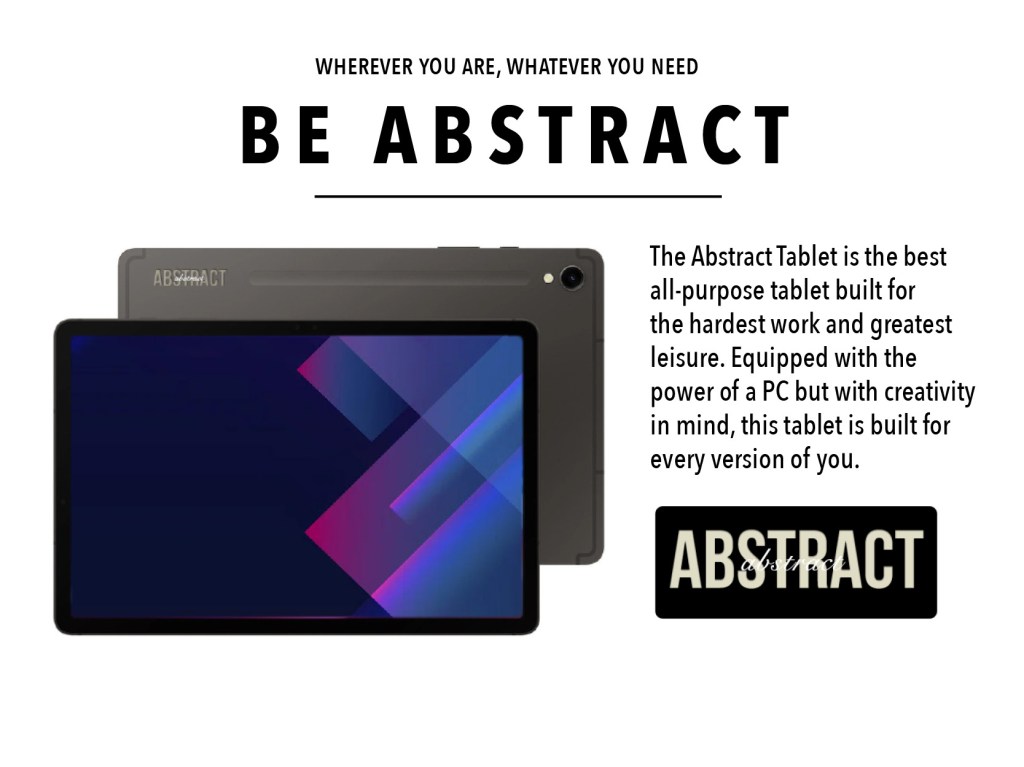
To manipulate brand anthropomorphism, I created two different versions of an advertisement for a fictional tablet brand, Abstract. The control (no anthropomorphism) is structured as a typical ad with a headline, body text, image, etc.. The treatment (anthropomorphism) is similar, except eyes and a mouth were put on the tablet. The body copy was also made to look like the tablet is talking “at” you, with slight changes in the text to incorporate I/We pronouns. These conditions were randomly assigned to participants.
No Brand Anthropomorphism
Brand Anthropomorphism
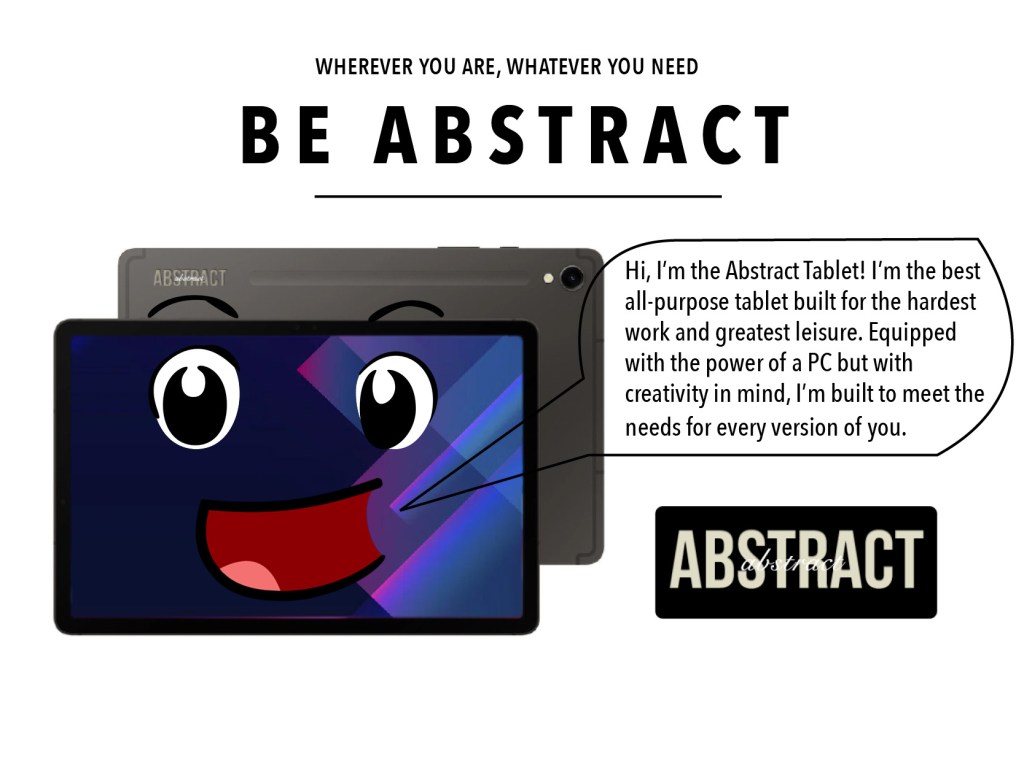
Involvement was manipulated by randomly assigning participants to one of two shopping scenarios to immerse themselves into. One scenario had participants immerse themselves into a situation where their old tablet broke and they are actively searching online for a new tablet when they come across one of the ads above: this is the high-involvement condition. Other participants immersed themselves into a scenario where they were looking online for running shoes and came across this ad: since their goal is to find shoes, coming across a tablet advertisement should be seen as irrelevant and not highly important, thus this is the low-involvement condition.
After being randomly assignment to involvement conditions and then brand anthropomorphism conditions, participants filled out an online questionnaire measuring their attitude toward brand, attitude toward ad, purchase intention, warmth, and competence for the advertisement they just read.
Results
I used SPSS to analyze my results. A two-way ANOVA was used to test the effects of involvement x brand anthropomorphism and the PROCESS Macro model 4 was used to test the mediating effect of warmth and competence.
The biggest finding from my analysis is that perceived competence mediated the relationship between brand anthropomorphism and attitude toward brand, attitude toward ad, and purchase intention. This was initially posed as a research question, but significant results help contribute to a more concrete relationship between brand anthropomorphism and competence.
The presence of brand anthropomorphism results in a lower perceived competence and since competence already positively regresses on attitude toward brand, attitude toward ad, and purchase intention, an indirect effect between brand anthropomorphism and these three dependent variables was established.
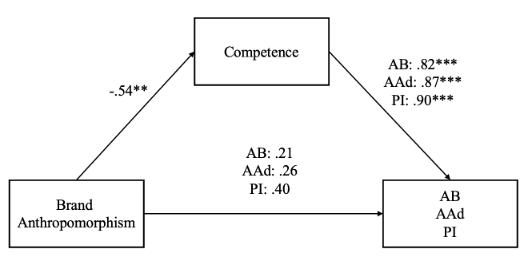
Literature would suggest that warmth (friendliness, trustworthiness, etc.) would be what consumers first think of when viewing brand anthropomorphism but these results suggest that brand anthropomorphism may firstly be a measure of intelligence and capability. Since the results show that attitudes and intentions are decreased by brand anthropomorphism through the indirect effect of lowered competence, this likely means that brands that identify as “competent” (e.g. Apple) should avoid using brand anthropomorphism in their communication. Its use may risk “dumbing” the brand down through lowered competence.
The roles of involvement and mediation effect of warmth were not supported in my analysis. These non-significant findings however, bring their own set of theoretical and managerial implications. If you would like more detail on those, feel free to read my thesis more in-depth! (attached at the bottom of this page)
Thesis Defense & Conclusion
The results from my analysis helped me form the following conclusions:
1. Consumer’s involvement does not play a significant role in processing brand anthropomorphism.
2. Perceived competence has the biggest impact on consumer’s attitudes and intentions towards the brand/ad.
3. Brand anthropomorphism on its own is not an effective strategy. Alone, it lacks the power to spur attitudinal shift; it needs to used as a supplemental strategy to existing and established arguments.
Overall, I am happy that in my opinion, this thesis did provide meaningful contribution to brand anthropomorphism literature, specifically helping fill the research gap of consumer’s internal processing. The mediating effect of competence was particularly exciting to uncover for myself!
On April 30th, 2024, I successfully defended this thesis in front of an audience of professors, friends, colleagues, and even some of my own students! I want to particularly thank the professors who agreed to be on my thesis defense committee: Dr. Sang-Hwa Oh, Dr. Sela Sar, and especially Dr. Chang-Dae Ham, who was my advisor for this project.
This was by far the most challenging endeavor I faced in grad school and was formative in my development as a researcher. This was a highly-condensed version of my thesis. If you would like to read more on the theories used, literature explored, results, or discussion, I have attached the full document below. Thank you!

Masashi Fukada’s M.S. in Advertising Thesis:
 masashifukada.com